
In the world of industrial automation and smart electronics, proximity sensors are the unsung heroes. They allow machines to “see” and interact with their environment without physical contact.
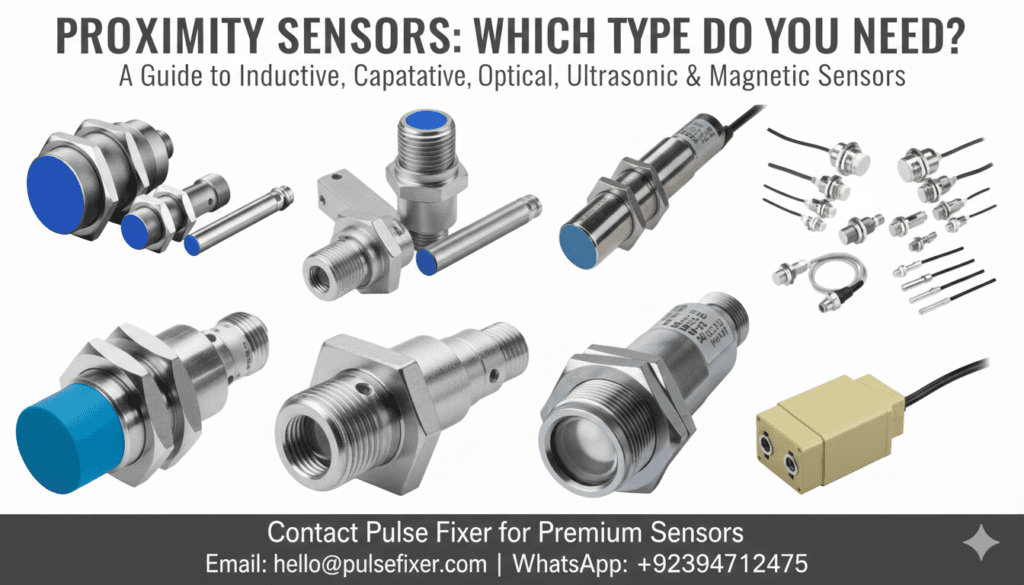
Whether you are looking to detect metal on a high-speed assembly line or monitor liquid levels in a tank, choosing the right sensor is critical. In this guide, we break down the five primary types of proximity sensors, their working principles, and their best applications.
What is a Proximity Sensor?
A proximity sensor is a non-contact device that detects the presence of an object (often called the “target”) when it enters the sensor’s field. Because there is no mechanical contact, these sensors offer high reliability and a long functional life.
5 Common Types of Proximity Sensors
1. Inductive Proximity Sensors
Best for: Metallic Objects
Inductive sensors operate on the principle of inductance. They use a fluctuating magnetic field to induce eddy currents in metal targets.
- Key Feature: Extremely robust in harsh, oily, or dirty environments.
- Limitation: Can only detect ferrous and non-ferrous metals.
2. Capacitive Proximity Sensors
Best for: Non-Metallic Materials (Liquids, Powders, Plastics)
These sensors detect changes in capacitance between the sensor and the target.
- Key Feature: They can “see through” non-metallic containers (like plastic or glass) to detect the liquid level inside.
- Limitation: Highly sensitive to humidity and environmental vapors.
3. Optical (Photoelectric) Proximity Sensors
Best for: General Object Detection & Counting
Optical sensors consist of a light source (usually Infrared or LED) and a receiver. They detect objects by measuring the light reflected back from the object’s surface.
- Key Feature: Fast response times and medium-range detection.
- Limitation: Performance can be affected by dust or the color/transparency of the object.
4. Ultrasonic Proximity Sensors
Best for: Distance Measurement & Clear Objects
These sensors emit high-frequency sound waves. By measuring the time it takes for the echo to return, they determine the distance and presence of an object.
- Key Feature: Unaffected by target color or transparency (great for glass and water).
- Limitation: Sensitive to air temperature changes and extreme surface textures.
5. Magnetic Proximity Sensors
Best for: Detecting Magnets through Walls
Based on mechanical or Hall-effect principles, these sensors only react to magnetic fields.
- Key Feature: Can detect a magnet through non-magnetic barriers like stainless steel, aluminum, or plastic.
- Limitation: Requires the target object to be magnetized.
Comparison Table: Which Sensor Do You Need?
| Type | Target Material | Sensing Range | Durability | Cost |
| Inductive | Metal Only | Short (<50mm) | Very High | Low |
| Capacitive | All Materials | Short (<50mm) | High | Medium |
| Optical | All Materials | Medium (<100mm) | High | Medium |
| Magnetic | Magnets Only | Medium (<80mm) | High | Low |
| Ultrasonic | All Materials | Long (Up to 15m) | Medium | High |
Industrial Applications
Proximity sensors are utilized across various industries for:
- Object Counting: Packaging lines and conveyor belts.
- Level Sensing: Monitoring liquids in food and chemical industries.
- Speed Monitoring: Gear checking and velocity measurement.
- Safety: Obstacle detection for forklifts and robotics.
Need High-Quality Sensors? Contact Pulse Fixer!
If you are looking to purchase high-quality proximity sensors for your project or industrial facility, Pulse Fixer is here to help. We provide expert guidance and reliable components.
Get a Quote Today:
- 📧 Email:hello@pulsefixer.com
- 📱 WhatsApp/Call:+92 339 4712475